
Understanding Nutrition and Food Claims

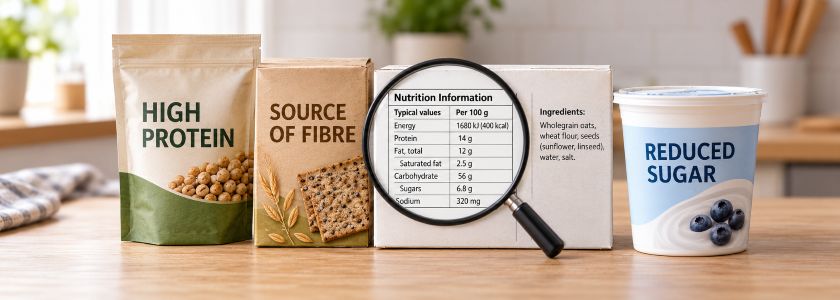
Food packages often use short statements such as “high protein”, “low fat”, “source of fibre” or other front-of-pack wording to draw attention to particular features of a product. These statements can be useful, but they do not replace reading the complete Nutrition Information Panel and ingredient list.
This guide explains how to understand nutrition content claims, health claims and other common food-label wording in Australia, including how claims are regulated, what they do and do not tell you, and how to check them against the detailed product label.
What Is a Nutrition Content Claim?
A nutrition content claim describes the presence, absence or amount of a nutrient, energy or another substance in a food.
Examples can include claims relating to:
- protein;
- dietary fibre;
- fat or saturated fat;
- sugars;
- sodium;
- vitamins and minerals; and
- energy.
Claims such as “low fat” or “good source of calcium” must meet applicable conditions in the Australia New Zealand Food Standards Code.
A nutrition content claim describes one characteristic of the food. It should not be treated as a complete assessment of the product.
What Is a Health Claim?
A health claim goes further than describing nutrient content. It describes or implies a relationship between a food, nutrient or other property of food and a health effect.
Food Standards Australia New Zealand divides health claims into two main types:
- general level health claims; and
- high level health claims.
All permitted health claims must be supported by scientific evidence and meet the applicable requirements of the Food Standards Code.
Nutrition Claims and Health Claims Are Different
A useful distinction is:
- nutrition content claim — tells you something about what the food contains; and
- health claim — describes a relationship between the food or one of its properties and a health effect.
Both types of claim are voluntary, but when a business chooses to make one, the applicable regulatory requirements must be met.
What Is a General Level Health Claim?
A general level health claim describes a relationship between a food, nutrient or other food property and a health effect that is not a serious disease or biomarker of serious disease.
Food businesses can use:
- food-health relationships already approved in the Food Standards Code; or
- certain self-substantiated food-health relationships established using the required scientific process.
Where a business relies on a self-substantiated general level health claim, Food Standards Australia New Zealand must be notified in accordance with the applicable requirements.
What Is a High Level Health Claim?
A high level health claim relates a food, nutrient or other property of food to a serious disease or to a biomarker of a serious disease.
These claims are subject to stricter requirements and must use food-health relationships that have been pre-approved under the Food Standards Code.
Food Standards Australia New Zealand currently lists a limited number of approved high level food-health relationships.
Health Claims Must Be Supported by Evidence
Health claims cannot simply be created as advertising statements without an appropriate evidence basis.
Food Standards Australia New Zealand requires permitted health claims to be supported by scientific evidence according to the framework in Standard 1.2.7.
This does not mean every food making a permitted health claim is nutritionally identical or equally suitable for every customer. The complete food still needs to be considered.
What Is the Nutrient Profiling Scoring Criterion?
Foods generally need to meet the Nutrient Profiling Scoring Criterion, often abbreviated to NPSC, before a health claim can be made.
The NPSC is a regulatory tool used to determine whether a food is eligible to carry health claims based on aspects of its nutritional composition.
It should not be interpreted as a personal dietary recommendation or as a complete ranking of every food.
Claims Can Add Extra Information to the Nutrition Panel
A standard Nutrition Information Panel shows energy, protein, total fat, saturated fat, carbohydrate, sugars and sodium.
Where a claim is made about another nutrient, additional information may need to be declared in the Nutrition Information Panel.
For example, if a food makes an applicable fibre claim, dietary fibre information may also need to appear.
For more detail on the panel itself, see How to Read a Nutrition Information Panel.
How to Read a “High Protein” Claim
A protein claim should be checked against the detailed Nutrition Information Panel rather than used on its own.
Review:
- protein per serving;
- protein per 100 g;
- serving size;
- energy;
- total and saturated fat;
- carbohydrate and sugars;
- sodium; and
- the ingredient list.
A product highlighting protein can still differ substantially from another product in its overall nutrition profile.
See Understanding Protein, Carbohydrate & Fat on Food Labels for more detail.
How to Read Fibre Claims
Foods can make claims relating to dietary fibre when the applicable conditions are met.
When comparing fibre claims, check:
- the exact wording of the claim;
- the dietary fibre amount declared on the label;
- serving size;
- the ingredient list; and
- the rest of the nutrition profile.
A fibre claim highlights fibre content but does not provide a complete assessment of the food.
How to Read Sugar Claims
Sugar-related claims can include wording such as:
- low sugar;
- reduced sugar;
- no added sugar; and
- other permitted claims relating to sugars.
These phrases are not interchangeable.
For example, “no added sugar” does not necessarily mean that a food contains no sugars, because naturally occurring sugars may still be present.
Check the exact claim, total sugars in the Nutrition Information Panel and the ingredient list together.
See Understanding Sugar on Food Labels for a detailed explanation of sugar claims and comparisons.
“Reduced” Is a Comparative Claim
Words such as “reduced” or similar comparative claims indicate a comparison with a reference food.
This is different from a claim that a food is absolutely “low” in a nutrient.
A product can therefore contain less of a nutrient than its reference food without necessarily meeting the requirements for a separate low-content claim.
When you see a comparative claim, check:
- what nutrient is being compared;
- what the reference food is;
- the actual nutrition values; and
- whether the serving sizes being compared are equivalent.
“Free” and “Low” Claims Have Specific Meanings
Terms such as “free” and “low” can sound like general advertising language, but many nutrition content claims using these terms are subject to specific regulatory conditions.
Do not assume that two different words mean the same thing.
Use the exact wording on the package and verify it against the Nutrition Information Panel and other label information.
Claims Do Not Cancel Out Other Nutrients
A food carrying a claim about one nutrient can still contain meaningful amounts of other nutrients.
For example:
- a high-protein food can still contain saturated fat or sodium;
- a lower-sugar product can differ in energy or fat;
- a source-of-fibre product can still vary considerably in sugars or sodium; and
- a reduced-fat product can differ from its reference food in other ingredients or nutrients.
Always review the complete Nutrition Information Panel.
Read the Ingredient List as Well
A claim tells you something specific about a product, but the ingredient list tells you what the food is made from.
Reading both can help answer questions such as:
- What are the main ingredients?
- What ingredient provides the highlighted nutrient?
- Are sweeteners or flavouring ingredients present?
- Are vitamins or minerals added?
- Are allergens present?
- Is the product a simple food or a multi-ingredient formula?
See How to Read a Food Ingredient List for more detail.
Not Every Front-of-Pack Phrase Is a Nutrition or Health Claim
Food packaging can contain many kinds of descriptive or marketing wording.
Terms such as “natural”, “plant-based”, “traditional”, “premium” or similar descriptions are not automatically the same type of claim as a regulated nutrition content claim or health claim under Standard 1.2.7.
However, food labels and advertising must not create a false, misleading or deceptive impression.
The practical approach is to identify what the statement actually says and then check whether the detailed product information supports the impression it creates.
What About “Organic” Claims?
“Organic” is different from a nutrition content or health claim.
The Australian Competition and Consumer Commission states that products supplied in Australia do not generally need to be certified to use an organic description, but businesses making organic claims must be able to substantiate those claims.
If a product states that it is certified organic, check the certification information provided rather than assuming every organic claim represents the same certification system.
Organic status also does not, by itself, describe the complete nutrition profile of a food.
“Plant-Based” Does Not Describe the Complete Nutrition Profile
A plant-based description can provide useful information about how a product is formulated or positioned, but it does not tell you how much protein, fat, carbohydrate, sugar, sodium or fibre the product contains.
Two plant-based products can have very different:
- ingredient lists;
- protein levels;
- fat profiles;
- carbohydrate and sugar amounts;
- sodium levels; and
- serving sizes.
Use the detailed label rather than treating the phrase alone as a nutrition assessment.
“Natural” Should Not Replace Label Reading
Words such as “natural” can influence how customers perceive a product, but they do not replace the ingredient list or Nutrition Information Panel.
When a broad marketing description appears on a package, ask:
- What exactly is being described?
- What ingredients are actually present?
- What does the Nutrition Information Panel show?
- Is there additional wording that qualifies the claim?
Businesses are responsible for ensuring that representations about their products are not false or misleading.
Look at the Overall Impression of the Package
Customers do not read individual words in isolation. Images, colours, prominent claims and smaller qualifying text can all affect the overall impression of a product.
Australian fair trading and food laws prohibit false, misleading or deceptive representations.
This means a useful label review should consider both the prominent front-of-pack wording and the detailed information elsewhere on the package.
Serving Size Can Affect How Claims Feel in Practice
A claim may meet its regulatory conditions, but the amount you actually consume still matters.
Check:
- the labelled serving size;
- how many servings are in the package;
- your likely portion; and
- per-100 g or per-100 mL values when comparing similar foods.
For more detail, see Understanding Serving Sizes on Food Labels.
Compare Like With Like
Claims are most useful when comparing similar food products.
For example, comparing two similar snack products can help show differences in protein, fibre, sugars or fat.
Comparing a greens powder with a snack bar based on one claim is less useful because the products serve very different purposes.
For broader food comparisons, see the Health Foods Guide.
A Practical Food Claims Checklist
- Identify the exact wording. Do not assume similar terms have the same regulatory meaning.
- Is it a nutrition content claim? Check what nutrient or substance is being highlighted.
- Is it a health claim? Look for wording that links a food or nutrient with a health effect.
- Check the Nutrition Information Panel. Verify the actual nutrient amounts.
- Check the serving size. Per-serving figures depend on the stated serve.
- Use per 100 g or per 100 mL. This can help compare similar foods using different servings.
- Read the ingredient list. Understand what the food is actually made from.
- Check comparative claims carefully. Find out what food or formulation is being used as the reference.
- Do not judge the product by one claim. Review the complete nutrition profile.
- Consider broader marketing wording separately. Terms such as organic or plant-based are not automatically nutrition or health claims.
- Check the overall impression. Labels and advertising must not be false or misleading.
- Always use the current label. Claims and formulations can change.
Frequently Asked Questions
What is a nutrition content claim?
It is a claim about the presence, absence or amount of a nutrient, energy or another substance in a food, such as a claim relating to protein, fibre, fat or sugars.
What is a health claim?
A health claim describes a relationship between a food, nutrient or other property of food and a health effect.
Are health claims regulated?
Yes. Health claims must comply with Standard 1.2.7 of the Food Standards Code and must be supported by scientific evidence.
What is the difference between general and high level health claims?
General level health claims concern health effects that are not serious diseases or biomarkers of serious disease. High level health claims relate to serious diseases or their biomarkers and must use pre-approved food-health relationships.
Does a nutrition claim mean a food is healthy overall?
No. A nutrition content claim describes a particular feature of the food. Always check the complete Nutrition Information Panel, ingredient list and serving size.
Does “reduced” mean the same as “low”?
No. A reduced claim compares a food with a reference food, while a low-content claim has its own applicable conditions.
Does “no added sugar” mean sugar free?
No. A product meeting the requirements for a no-added-sugar claim can still contain naturally occurring sugars. Check the total sugars value in the Nutrition Information Panel.
Is “organic” a nutrition content claim?
No. Organic wording is a different type of representation. In Australia, businesses making organic claims must be able to substantiate them, but organic status does not itself describe the complete nutrition profile.
Does “plant-based” mean a food is nutritionally better?
Not automatically. Plant-based products can differ substantially in ingredients, protein, fat, carbohydrate, sugars, sodium and fibre.
Can packaging wording be misleading even if individual statements appear factual?
The overall impression matters. Australian food and fair trading laws prohibit false, misleading or deceptive representations, so wording, imagery and qualifying information need to be considered together.
Further Information
- Food Standards Australia New Zealand — Nutrition Content Claims and Health Claims
- Food Standards Australia New Zealand — Nutrition, Health and Related Claims
- Food Standards Australia New Zealand — Nutrition Information Panels
- Food Standards Australia New Zealand — Truth in Labelling
- Australian Competition and Consumer Commission — Organic Claims
Important Information
This guide provides general information about nutrition content claims, health claims and other wording used on packaged food labels. It is not intended to provide personalised dietary, medical or legal advice and does not replace advice from an appropriately qualified professional.
Food-labelling requirements depend on the type of claim, product and applicable provisions of the Australia New Zealand Food Standards Code and other laws. If you require personalised nutrition advice, have a medical condition or need advice about a particular food claim, seek appropriately qualified professional advice.
Always check the complete current package, including the exact claim wording, Nutrition Information Panel, ingredient list, allergen information, serving size, preparation directions and any qualifying statements.
Product formulas, directions and warnings can change. Always check the current product label before purchase and use.