
Understanding Serving Sizes on Food Labels

Serving sizes on food labels can make a significant difference to how nutrition information appears. Two similar foods can use different stated serving sizes, so comparing only the “per serving” numbers may not give you a like-for-like comparison.
This guide explains how serving sizes work on Australian food labels, including servings per package, per-serving values, per-100 g or per-100 mL comparisons, actual portion size and the difference between a manufacturer's labelled serving and a standard serve used in Australian dietary guidance.
Where Is the Serving Size Shown?
On most packaged foods, the serving size appears near the top of the Nutrition Information Panel.
You will commonly see information such as:
- servings per package; and
- serving size, usually expressed in grams or millilitres.
A household measure or product unit may also help describe the serving, such as one bar, one scoop, one sachet or a particular number of pieces.
For a broader explanation of the complete panel, see the How to Read a Nutrition Information Panel Guide.
Who Decides the Serving Size on the Label?
Food Standards Australia New Zealand states that the serving size shown in the Nutrition Information Panel is determined by the food business.
This means two similar products can legitimately use different serving sizes.
For example, one snack product might define a serving as 30 g while another similar product uses 45 g. Their per-serving nutrition values will therefore be based on different amounts of food.
This is one reason the per-100 g or per-100 mL column is so useful when comparing similar products.
A Label Serving Is Not Automatically Your Portion
The labelled serving is the amount used to calculate the per-serving nutrition information. It does not necessarily match the amount you personally eat or drink at one time.
Your actual portion may be:
- smaller than the stated serving;
- approximately the same;
- larger than the stated serving; or
- the entire package even when the package contains several stated servings.
Understanding that difference is important when using per-serving nutrition information.
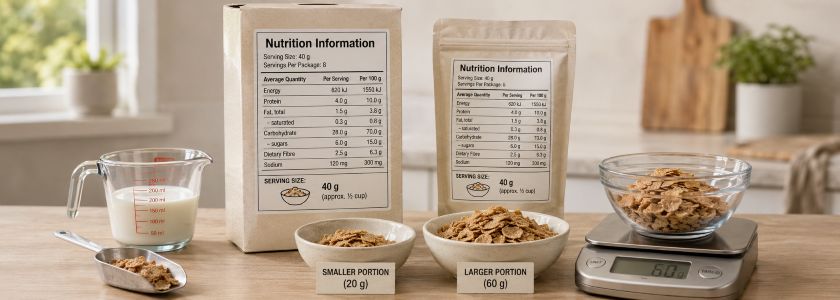
Serving Size, Portion Size and Standard Serve Are Different
These terms can sound similar, but they do not always mean the same thing.
Serving size on a food label is the quantity used by the food business for the Nutrition Information Panel.
Portion size is the amount of food or drink you actually consume at a particular time.
Standard serve is also used in the Australian Dietary Guidelines, where set serve sizes are used to describe amounts from the five food groups.
A serving shown on a packaged-food label should therefore not automatically be assumed to equal one Australian Dietary Guidelines standard serve.
What Does “Servings per Package” Mean?
The servings-per-package figure tells you approximately how many of the stated servings are contained in the package.
This can be particularly important when a package looks like a single-use product but the label defines it as containing more than one serving.
For example, if a package contains two stated servings and you consume the whole package, your intake would generally be approximately twice the values shown in the per-serving column.
Always check both:
- the serving size; and
- the number of servings per package.
What Does “Average Quantity per Serving” Mean?
The per-serving column shows the average amount of energy and listed nutrients in the serving size stated on the label.
This column can help answer questions such as:
- How much energy is in one stated serving?
- How much protein does one serving provide?
- How much saturated fat is in one serving?
- How much sugar is in one serving?
- How much sodium is in one serving?
It is most useful when the amount you actually consume is reasonably close to the stated serving.
What If You Eat More Than One Serving?
If you consume more than the stated serving, the nutrition contribution increases accordingly.
For a simple example, imagine a food with:
- serving size: 25 g;
- energy per serving: 400 kJ; and
- two servings consumed: 50 g.
Consuming two stated servings would provide approximately 800 kJ, assuming the food is consumed exactly as represented by the panel.
The same principle applies to the other per-serving nutrient values.
What If You Eat Half a Serving?
If you consume half of the stated serving, you would generally consume approximately half of the listed per-serving nutrient amounts.
This can be useful when a manufacturer's serving is larger than the portion you normally eat.
However, there is usually no need to perform detailed calculations when making a simple comparison between two similar foods. The per-100 g or per-100 mL column is often easier for that purpose.
Why Per 100 g Is Better for Many Product Comparisons
The per-100 g column places solid and semi-solid foods on the same weight basis.
This means you can compare similar products even when their manufacturers use different serving sizes.
For example:
- Product A serving size: 30 g;
- Product B serving size: 45 g.
Comparing their per-serving sugar, protein or sodium values directly could create a misleading impression because Product B's figures are based on 50% more food.
Comparing both products per 100 g removes that serving-size difference.
For Liquids, Use Per 100 mL
For liquid foods and drinks, the equivalent standard comparison is generally per 100 mL.
As with solid foods, the per-serving column tells you what the stated serve provides, while per 100 mL helps you compare similar drinks on the same volume basis.
Per Serving and Per 100 g Answer Different Questions
Neither column is universally “better”. They have different purposes.
Use per serving when you want to know:
- what the manufacturer's stated serve provides;
- approximately what you would consume from that amount; or
- how the stated serving fits into your intended use of the product.
Use per 100 g or per 100 mL when you want to:
- compare similar products with different serving sizes;
- compare nutrient concentration; or
- avoid being influenced by unusually small or large stated servings.
A Smaller Serving Can Produce Smaller Per-Serving Numbers
If two similar foods have comparable nutrient composition but one uses a smaller stated serving, its per-serving energy, sugars, sodium or fat values will generally appear lower.
That does not necessarily mean the product contains less of those nutrients when the same quantity of food is compared.
Always check the serving size before interpreting the per-serving column.
A Larger Serving Can Produce Larger Per-Serving Numbers
The reverse is also true.
A product with a larger stated serving may appear to contain more energy, protein or another nutrient per serving simply because more food is included in that serving.
This is especially relevant for products promoted around a particular nutrient such as protein.
Check both the amount per serving and the amount per 100 g before deciding that one similar product is more concentrated than another.
Do Not Assume One Package Equals One Serving
Some packaged foods contain several servings even if the package could realistically be consumed at one time.
Before using the per-serving numbers, check whether the pack contains:
- one serving;
- two servings;
- several servings; or
- a larger number of portions intended to be measured separately.
This is particularly useful for larger bags, powders, drinks, snack products and multi-use containers.
Scoops, Spoons and Pieces Can Be Misleading Without the Weight
A serving may be described using a scoop, spoon, piece or other household measure.
Those descriptions are convenient, but the gram or millilitre amount gives you a more precise basis for comparison.
For example, two powders might each recommend “one scoop”, but the scoops could hold different amounts.
When comparing powders such as Greens Powders & Superfood Blends, check the stated weight of the serving rather than comparing scoop count alone.
Prepared Foods May Need Extra Attention
Some products are eaten as sold, while others are prepared with water, milk or additional foods.
The label may provide nutrition information for the product as sold, as prepared, or additional information relevant to preparation depending on the product and applicable requirements.
Check:
- what the stated serving refers to;
- whether the figures apply before or after preparation;
- what additional ingredients are required; and
- whether those additions contribute additional energy or nutrients.
A powder mixed only with water and the same powder mixed with milk, fruit or other foods can form part of very different overall portions.
Serving Size Does Not Tell You Whether a Food Is “Healthy”
The serving size is a measurement used to present nutrition information. It does not provide a complete judgement of a food's nutritional quality.
Consider the serving information alongside:
- the complete Nutrition Information Panel;
- the ingredient list;
- allergen information;
- the type of food;
- how you intend to use it; and
- the rest of your overall diet.
For broader food comparisons, see the Health Foods Guide.
Use the Ingredient List as Well
Serving-size information explains the quantity used for the nutrition calculations, but it does not tell you what ingredients make up the food.
The ingredient list provides that additional context.
For example, two snacks can have similar serving sizes and energy values but use very different main ingredients.
See How to Read a Food Ingredient List for guidance on ingredient order, compound ingredients, additives, percentage labelling and allergens.
Comparing Serving Sizes Step by Step
- Check that the products are reasonably similar in type and intended use.
- Find the serving size on each Nutrition Information Panel.
- Check how many servings each package contains.
- Compare the gram or millilitre serving amounts rather than household measures alone.
- Review the per-serving nutrition values.
- Use the per-100 g or per-100 mL column for a like-for-like comparison.
- Consider how much of the product you would realistically consume.
- Check whether preparation changes the final food or drink.
- Read the ingredient list and other relevant label information as well.
A Practical Serving Size Checklist
- What is the stated serving? Check the grams or millilitres.
- How many servings are in the package? Do not assume the whole pack is one serving.
- Who set the serving size? Remember that the food business determines the label serving.
- Is your likely portion different? Consider how much you would actually eat or drink.
- Are you comparing similar products? Serving-size comparisons are most useful between like products.
- Are the stated serves different? If so, avoid comparing only the per-serving nutrient values.
- Have you checked per 100 g or per 100 mL? Use this for a common comparison basis.
- Does the serving use a scoop or household measure? Check the corresponding weight or volume.
- Does preparation change the product? Review the preparation directions and relevant nutrition information.
- Have you checked the complete label? Use the serving information together with the Nutrition Information Panel and ingredient list.
Frequently Asked Questions
Who determines the serving size on a food label?
The food business determines the serving size used in the Nutrition Information Panel, so similar products can have different stated serving sizes.
Is the serving size on the label the amount I should eat?
Not necessarily. It is the quantity used to provide the per-serving nutrition information. Your actual portion can be smaller or larger, and Australian Dietary Guidelines standard serves are a separate concept.
Is serving size the same as portion size?
No. The labelled serving is the amount used for the Nutrition Information Panel, while your portion is the amount you actually eat or drink.
Is a label serving the same as an Australian Dietary Guidelines standard serve?
Not necessarily. Australian dietary guidance uses defined standard serves for foods in the five food groups, while a food business determines the serving size shown on its Nutrition Information Panel.
What does servings per package mean?
It tells you approximately how many of the stated serving sizes are contained in the package. A package can contain more than one serving.
Should I compare foods per serving or per 100 g?
Use per serving to understand what the stated serving provides. Use per 100 g, or per 100 mL for liquids, when comparing similar products with different serving sizes.
If I eat two servings, do I double the nutrition values?
Generally, yes. If you consume twice the stated serving, you would consume approximately twice the listed per-serving amounts.
Does a smaller serving mean a product is lower in sugar or sodium?
Not necessarily. A smaller serving can produce smaller per-serving numbers simply because less food is being counted. Use the per-100 g or per-100 mL column when comparing similar products.
Why do two similar products use different serving sizes?
The food business determines its labelled serving size, so serving sizes can vary between products. This is one reason Nutrition Information Panels also provide standardised per-100 g or per-100 mL information.
Further Information
- Food Standards Australia New Zealand — Nutrition Information Panels
- Eat For Health — What Is a Serve?
- Eat For Health — Serve Sizes
Important Information
This guide provides general information about understanding serving sizes on packaged food labels. It is not intended to provide personalised dietary or medical advice and does not replace advice from an appropriately qualified health professional.
The serving size shown in a Nutrition Information Panel is used to calculate per-serving nutrition information and may differ from the amount an individual actually consumes or from a standard serve used in Australian dietary guidance. Individual nutrition requirements vary according to factors such as age, life stage, activity level, medical conditions and overall dietary pattern.
Always check the complete current food label, including serving size, servings per package, Nutrition Information Panel, ingredient list, allergen information, preparation directions and any relevant claims or warnings.
Product formulas, directions and warnings can change. Always check the current product label before purchase and use.