
Understanding Protein, Carbohydrate & Fat on Food Labels

Protein, carbohydrate and fat are major components of many foods and are commonly compared using the Nutrition Information Panel. However, the numbers can be misleading if you compare different serving sizes, add subcategories to their parent values or focus on a single nutrient without considering the rest of the food.
This guide explains how to read protein, carbohydrate and fat on Australian food labels, including total fat, saturated fat, sugars, serving sizes, per-100 g comparisons and how to compare similar packaged foods more consistently.
Where Are Protein, Carbohydrate and Fat Shown?
Most packaged foods in Australia display a Nutrition Information Panel, often called an NIP.
A standard panel includes average quantities of:
- energy;
- protein;
- fat, total;
- saturated fat;
- carbohydrate;
- sugars; and
- sodium.
These values are normally shown both per serving and per 100 g, or per 100 mL for liquids.
For a complete walkthrough of the panel, see How to Read a Nutrition Information Panel.
Start With the Serving Size
Before comparing protein, carbohydrate or fat, check the serving size near the top of the Nutrition Information Panel.
The food business determines the labelled serving size, so two similar products can use different serving amounts.
For example, one snack might use a 30 g serving while another uses 45 g. Their per-serving protein, carbohydrate and fat values are therefore calculated from different quantities of food.
If serving sizes differ, the per-100 g or per-100 mL column usually provides a more consistent comparison.
Per Serving and Per 100 g Answer Different Questions
Per serving shows what the manufacturer-defined serving provides.
Per 100 g, or per 100 mL for liquids, places similar products on a common weight or volume basis.
Use per serving when you want to understand the stated portion. Use per 100 g or per 100 mL when comparing the concentration of nutrients in similar products.
See Understanding Serving Sizes on Food Labels for more detail.
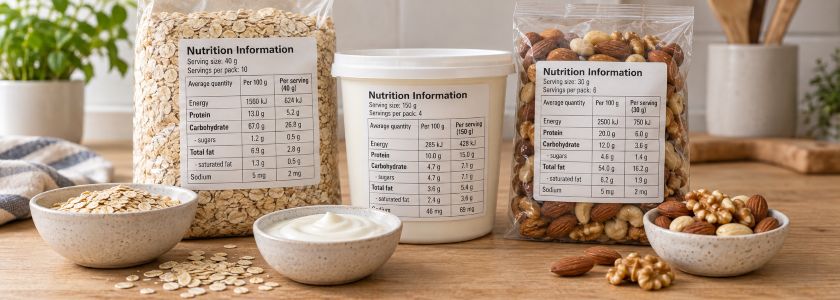
Understanding Protein
Protein is normally shown in grams on the Nutrition Information Panel.
If protein is important to your comparison, look at both:
- grams of protein per serving; and
- grams of protein per 100 g.
The per-serving figure tells you what the stated serving provides, while the per-100 g figure helps show how protein-concentrated the food is compared with a similar product.
A Higher Protein Number per Serving Can Reflect a Larger Serving
A product can show more protein per serving simply because its stated serving is larger.
For example, if two similar foods have approximately the same protein concentration but one uses a larger serving size, that product will naturally show more protein per serving.
This is why a useful comparison should check:
- serving size;
- protein per serving; and
- protein per 100 g.
Do not compare only the largest protein number on the label.
Protein Claims Need Context
Some foods highlight protein on the front of the pack or make a nutrition content claim relating to protein.
When comparing these products, check the detailed Nutrition Information Panel rather than relying only on the claim.
Also consider:
- energy;
- total and saturated fat;
- carbohydrate and sugars;
- sodium;
- serving size;
- dietary fibre where declared; and
- the ingredient list.
A protein-related claim describes one characteristic of the food rather than its complete nutrition profile.
Understanding Carbohydrate
Carbohydrate is shown in grams on the Nutrition Information Panel.
Food Standards Australia New Zealand explains that the carbohydrate value includes components such as starches and sugars.
The sugars line appears separately underneath carbohydrate but is already included within the carbohydrate figure.
You should therefore not add carbohydrate and sugars together.
Sugars Are Part of Carbohydrate
If a panel shows:
- carbohydrate: 30 g; and
- sugars: 8 g;
the 8 g of sugars is already included within the 30 g carbohydrate figure.
The remaining carbohydrate is not necessarily one single substance. The complete carbohydrate value can include different carbohydrate components depending on the food.
For a more detailed explanation, see Understanding Sugar on Food Labels.
Carbohydrate Is Not the Same as Sugar
Two similar products can contain the same amount of total carbohydrate but different amounts of sugars.
Likewise, a lower-sugar product can still contain substantial carbohydrate from other sources.
When carbohydrate matters to your comparison, review both:
- total carbohydrate; and
- the sugars line underneath it.
The ingredient list can provide additional context about where the carbohydrate comes from.
Dietary Fibre May Appear Separately
Dietary fibre is not one of the seven standard components that must always appear in every Nutrition Information Panel.
It may be declared when relevant, including where particular nutrition claims are made.
If fibre is shown, treat it as its own declared value rather than assuming it is already represented by the sugars line or another visible nutrient row.
Understanding Total Fat
The Nutrition Information Panel shows total fat in grams.
Total fat represents the combined fat present in the food, including different types of fatty acids.
Saturated fat must also be shown separately.
When comparing similar foods, check both values rather than using total fat alone.
Saturated Fat Is Already Included in Total Fat
Saturated fat forms part of the total fat amount.
If a food shows:
- total fat: 12 g; and
- saturated fat: 4 g;
the 4 g of saturated fat is already included within the 12 g total fat figure.
You should not add the two numbers together.
Why Other Types of Fat Sometimes Appear
Some Nutrition Information Panels contain additional fat information.
Depending on the product and claims made, this may include:
- monounsaturated fat;
- polyunsaturated fat;
- trans fat;
- omega-3 fatty acids;
- omega-6 fatty acids;
- omega-9 fatty acids; or
- cholesterol.
These additional rows do not mean every product is required to display the same expanded breakdown.
Where a relevant nutrition claim is made, additional nutrition information may need to appear in the panel.
Do Not Add Fat Subcategories to Total Fat
Just as saturated fat is already part of total fat, other declared fatty-acid categories can also form part of the total fat figure.
A useful rule when reading the panel is to recognise the hierarchy:
- Fat, total is the overall amount; and
- fatty-acid categories shown underneath describe parts of that total.
Do not add the subcategories again when interpreting the total.
Protein, Carbohydrate and Fat All Contribute to Energy
Protein, carbohydrate and fat all contribute energy to food.
This is one reason the energy value on the Nutrition Information Panel should be considered alongside the individual nutrient amounts rather than attempting to judge the product from one macronutrient alone.
Other components can also contribute energy, including dietary fibre and alcohol where present.
Do Not Judge the Food by Its Highest Macronutrient
A product being high in protein, lower in carbohydrate or lower in fat does not provide a complete assessment of its nutritional composition.
Different foods serve different purposes and naturally contain different proportions of protein, carbohydrate and fat.
For a useful comparison, consider:
- the type of food;
- serving size;
- energy;
- protein;
- total and saturated fat;
- carbohydrate and sugars;
- sodium;
- fibre where declared;
- ingredient list; and
- how the food is intended to be used.
Compare Like With Like
Nutrition-panel comparisons are most useful when the foods are reasonably similar.
For example, comparing two snack bars or two similar powdered foods can help show meaningful differences in protein, carbohydrate and fat.
Comparing completely different foods may tell you which contains more of a nutrient, but it does not necessarily tell you which product is more suitable because they may have different roles in the diet.
For broader comparison principles, see the Health Foods Guide.
Use the Ingredient List for Context
The Nutrition Information Panel gives you nutrient amounts, but it does not explain exactly which ingredients provide those nutrients.
The ingredient list can help show whether protein, carbohydrate and fat are coming from ingredients such as:
- grains;
- nuts and seeds;
- dairy ingredients;
- legumes;
- fruit ingredients;
- oils;
- protein ingredients; or
- other food components.
For ingredient-order and label-reading guidance, see How to Read a Food Ingredient List.
Watch for Different Product Formats
The same type of product can sometimes be sold in different formats, sizes or serving systems.
A powder, ready-to-drink product, bar and whole-food snack may use very different serving sizes and contain different amounts of water or other ingredients.
Do not assume that a direct per-serving comparison is meaningful simply because two products are marketed for a similar purpose.
Use the per-100 g or per-100 mL information where appropriate and consider the intended serving as well.
Prepared Products Can Change the Final Nutrition Profile
Some food products are consumed as sold, while others are mixed or prepared with additional ingredients.
If a powder is mixed with milk, yoghurt, fruit or another food, those additions contribute their own protein, carbohydrate, fat and energy.
Check whether the Nutrition Information Panel refers to:
- the product as sold;
- the product after preparation; or
- additional preparation information provided elsewhere on the label.
This helps avoid attributing nutrients from added ingredients to the packaged product itself.
How to Compare Protein, Carbohydrate and Fat Step by Step
- Make sure the foods are reasonably similar in type and intended use.
- Check each product's serving size.
- Review protein, carbohydrate and total fat per serving.
- Check sugars underneath carbohydrate and saturated fat underneath total fat.
- Use the per-100 g or per-100 mL column for a like-for-like comparison.
- Do not add sugars to carbohydrate or saturated fat to total fat.
- Check dietary fibre or additional fat information where declared.
- Review energy and sodium as well.
- Read the ingredient list for formulation context.
- Consider how much of the product you would realistically consume.
A Practical Macronutrient Label Checklist
- Check the serving size first. Per-serving numbers depend on it.
- Compare similar foods. Different product types may not provide useful direct comparisons.
- Check protein per serving and per 100 g. A larger serving can make protein per serving look higher.
- Remember sugars are part of carbohydrate. Do not add them together.
- Remember saturated fat is part of total fat. Do not add them together.
- Check additional nutrient rows. Fibre or specific fats may appear where relevant.
- Use per 100 g or per 100 mL. This helps when labelled serving sizes differ.
- Review energy and sodium too. Protein, carbohydrate and fat are not the entire nutrition profile.
- Read the ingredient list. It helps explain what the food is made from.
- Consider preparation. Added foods or drinks can change the final nutrient amounts consumed.
Frequently Asked Questions
Are protein, carbohydrate and fat shown on Australian food labels?
Yes. A standard Nutrition Information Panel includes protein, total fat and carbohydrate, along with saturated fat, sugars, energy and sodium.
Should I compare these nutrients per serving or per 100 g?
Both are useful. Per-serving values show what the stated serving provides, while per-100 g or per-100 mL values make it easier to compare similar products using different serving sizes.
Are sugars included in carbohydrate?
Yes. Sugars form part of the carbohydrate value and are also declared separately. Do not add sugars to carbohydrate.
Is saturated fat included in total fat?
Yes. Saturated fat is part of total fat and is shown separately to provide additional information. Do not add saturated fat to total fat.
Does a higher protein value per serving mean a product is more protein-dense?
Not necessarily. The product may simply use a larger serving. Compare protein per 100 g as well as protein per serving.
Why does dietary fibre appear on some labels but not others?
Dietary fibre is not one of the standard nutrients that must appear on every Nutrition Information Panel. It may be declared where relevant, including when certain nutrition claims are made.
Why do some labels show more types of fat?
Additional fatty-acid information can be declared where relevant, including when claims are made about particular types of fat or fatty acids.
Does lower carbohydrate, lower fat or higher protein automatically mean a food is better?
No. Those figures describe individual characteristics of the food. Consider the complete nutrition profile, ingredients, serving size, product type and overall dietary context.
Further Information
- Food Standards Australia New Zealand — Nutrition Information Panels
- Food Standards Australia New Zealand — Nutrition Panel Calculator
Important Information
This guide provides general information about interpreting protein, carbohydrate and fat on packaged food labels. It is not intended to provide personalised dietary or medical advice and does not replace advice from an appropriately qualified health professional.
Individual nutrition requirements vary according to factors such as age, life stage, activity level, medical conditions and overall dietary pattern. If you have specific macronutrient requirements, a medical condition or need personalised dietary advice, speak with an appropriately qualified health professional.
Always check the complete current label, including serving size, Nutrition Information Panel, ingredient list, allergen information, preparation directions and any relevant nutrition or health claims.
Product formulas, directions and warnings can change. Always check the current product label before purchase and use.