
Understanding Sugar on Food Labels

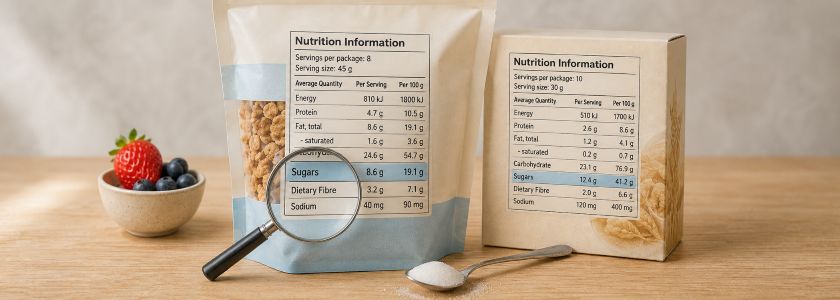
Sugar information on food labels can be confusing because the “sugars” value in the Nutrition Information Panel includes both sugars naturally present in ingredients and sugars added during manufacturing.
This guide explains how to read sugar information on Australian food labels, including total sugars, ingredient lists, per-serving and per-100 g comparisons, naturally occurring sugars, added sugars and common sugar-related claims.
Start With the Nutrition Information Panel
On most packaged foods, sugars appear as a separate line within the Nutrition Information Panel.
Food Standards Australia New Zealand explains that sugars are a type of carbohydrate, so they are included within the total carbohydrate figure and are also listed separately as sugars.
This means you should not add the carbohydrate and sugars numbers together.
For a broader walkthrough of the panel, see How to Read a Nutrition Information Panel.
What Does the “Sugars” Number Mean?
The sugars line shows the total amount of sugars in the food.
This can include:
- sugars naturally present in ingredients such as fruit or milk;
- sugars added as ingredients during manufacturing; and
- a combination of naturally occurring and added sugars.
The Nutrition Information Panel does not, by itself, tell you how much of the total sugars came from each source.
Use the Ingredient List as Well
The ingredient list helps provide context that the sugars number alone cannot.
Ingredients are generally listed in descending order according to their ingoing weight, so the position of sugar-containing ingredients can help you understand how the product is formulated.
However, the ingredient list does not tell you the total grams of sugars in the finished food. Use the Nutrition Information Panel for that amount.
See How to Read a Food Ingredient List for more detail.
Naturally Occurring Sugars and Added Sugars
Naturally occurring sugars are present naturally in foods such as fruit, vegetables and milk.
Added sugars are sugars and certain sugar-containing ingredients added during food production.
The standard sugars line in the Nutrition Information Panel combines these into a total sugars figure rather than separating them into two values.
That is why the ingredient list and any applicable sugar-related claims are useful when interpreting the NIP.
Added Sugars Are Not a Separate Standard NIP Line
As at 2026, Australian food labels are not generally required to show “added sugars” as a separate line in the standard Nutrition Information Panel.
Food Standards Australia New Zealand reviewed whether added sugars should be separately declared and closed that proposal in March 2026.
For customers, the practical approach remains to use:
- the total sugars value in the Nutrition Information Panel;
- the ingredient list;
- the serving size;
- per-100 g or per-100 mL information; and
- any regulated sugar-related claim on the package.
Per Serving vs Per 100 g
Sugar values are normally shown both per serving and per 100 g, or per 100 mL for liquids.
Per serving shows how much total sugar is present in the serving size stated by the food business.
Per 100 g or per 100 mL provides a common basis for comparing similar products that may use different serving sizes.
If two similar foods have different labelled serving sizes, comparing only their per-serving sugar amounts can be misleading.
For more detail, see Understanding Serving Sizes on Food Labels.
A Smaller Serving Can Make the Sugar Number Look Lower
If one product uses a 25 g serving and another uses a 40 g serving, the first product may show fewer grams of sugar per serving simply because less food is being counted.
This does not necessarily mean it contains less sugar when the same quantity of food is compared.
For similar foods, the per-100 g or per-100 mL column is usually the better place to make a direct comparison.
What Does “Low Sugar” Mean?
“Low sugar” is a regulated nutrition content claim rather than simply a marketing description.
Under the Food Standards Code, a food making a low-sugar claim must contain no more than:
- 5 g of sugars per 100 g for solid food; or
- 2.5 g of sugars per 100 mL for liquid food.
The presence of a low-sugar claim can therefore provide specific information, but it should still be considered alongside the complete ingredient list, serving size and nutrition profile.
What Does “Reduced Sugar” Mean?
A reduced-sugar or light/lite sugar claim is comparative.
Under the Food Standards Code, a product using this type of claim must contain at least 25% less sugars than the same amount of the reference food used for the comparison.
This means “reduced sugar” does not necessarily mean that the product is low in sugar in absolute terms.
Check the actual sugars value in the Nutrition Information Panel as well as the comparison being made.
What Does “No Added Sugar” Mean?
“No added sugar” does not mean “no sugar”.
A food can contain naturally occurring sugars even when it meets the requirements for a no-added-sugar claim.
Current Food Standards Code conditions for a “no added sugar” claim include restrictions on added sugars and also limits on the total sugars content of the finished food.
For the purposes of the current claim conditions, qualifying foods must not contain more than:
- 10 g of sugars per 100 g for solid food; or
- 7.5 g of sugars per 100 mL for liquid food.
There are additional technical conditions in the Food Standards Code, so the exact claim should be interpreted as a regulated label statement rather than simply as a synonym for “sugar free”.
“No Added Sugar” Is Not the Same as “Sugar Free”
These phrases describe different things.
A product with no added sugar can still contain naturally occurring sugars and show sugars in the Nutrition Information Panel.
Similarly, other sugar-related claims have their own regulatory conditions.
Do not assume that similar-looking front-of-pack wording has the same meaning.
Look Beyond the Word “Sugar” in the Ingredient List
Sugar-containing or sweetening ingredients can appear under a range of names.
Depending on the product, the ingredient list may include ingredients such as:
- sugar or sucrose;
- glucose;
- fructose;
- glucose syrup;
- golden syrup;
- molasses;
- honey;
- malt or malt extracts; or
- other sugar-containing ingredients.
The absence of the single word “sugar” does not therefore prove that a food contains no added or total sugars.
What About Fruit Ingredients?
Fruit and fruit-derived ingredients can contribute naturally occurring sugars to a food.
Depending on the way an ingredient has been processed and used, different regulatory rules can apply when assessing claims about added sugars.
For customers, the simplest approach is to avoid trying to reconstruct the complete sugar content from the ingredient list alone.
Use the Nutrition Information Panel for total sugars and treat any “no added sugar” or similar statement according to the regulated wording on the current package.
Sweeteners and Sugars Are Not the Same Thing
Some foods use intense sweeteners or other sweetening ingredients that do not contribute sugars in the same way as conventional sugars.
A product can therefore taste sweet while having a relatively low sugars value in the Nutrition Information Panel.
If this matters to your choice, check both:
- the sugars value in the Nutrition Information Panel; and
- the complete ingredient list for sweetening ingredients.
Do Not Judge a Food by Sugar Alone
Sugar is only one part of a food's nutrition profile.
When comparing similar products, also consider:
- energy;
- protein;
- total and saturated fat;
- sodium;
- dietary fibre where declared;
- serving size;
- the main ingredients; and
- the product's intended role in the diet.
A product with less sugar is not automatically nutritionally preferable in every other respect.
Check Sugar Claims in Context
Nutrition content claims are voluntary statements made by food businesses, but when they are used they must meet the applicable requirements of the Food Standards Code.
A sugar claim highlights one characteristic of the food rather than describing its entire nutrition profile.
For example, a reduced-sugar product can still differ from another product in:
- energy;
- saturated fat;
- sodium;
- protein;
- fibre;
- serving size; and
- ingredients.
Always check the complete label.
How to Compare Sugar Between Two Similar Products
- Make sure the foods are reasonably similar in type and intended use.
- Check each product's stated serving size.
- Compare total sugars per 100 g or per 100 mL.
- Check total sugars per serving to understand what the stated portion provides.
- Read the ingredient lists for additional context.
- Check whether either product makes a low-sugar, reduced-sugar, no-added-sugar or other relevant claim.
- Review the rest of the Nutrition Information Panel rather than comparing sugar alone.
Sugar Within an Overall Diet
Australian dietary guidance recommends limiting foods and drinks containing added sugars, particularly discretionary products such as confectionery and sugar-sweetened drinks.
At the same time, naturally occurring sugars can be present in nutritious foods such as fruit and milk.
This is another reason total sugars should be interpreted in the context of the food itself rather than treating every gram of sugar as nutritionally identical.
For broader comparisons across packaged nutrition products, see the Health Foods Guide.
A Practical Sugar Label Checklist
- Find the sugars line. Remember that it represents total sugars.
- Do not add sugars to carbohydrate. Sugars are already included within carbohydrate.
- Check the serving size. Smaller servings can produce smaller per-serving sugar values.
- Compare per 100 g or per 100 mL. This is particularly useful for similar products.
- Read the ingredient list. It provides context about where sugars may come from.
- Do not look only for the word “sugar”. Other sugar-containing ingredients may be used.
- Understand “no added sugar”. It does not mean the food contains no total sugars.
- Check regulated claims carefully. Low, reduced and no-added-sugar claims have specific conditions.
- Check the complete nutrition profile. Sugar is only one characteristic of a food.
- Always use the current label. Formulas and claims can change.
Frequently Asked Questions
Does the sugars line show added sugar?
Not separately. The sugars value in the Nutrition Information Panel is total sugars and includes both naturally occurring sugars and sugars added as ingredients.
Are added sugars listed separately in Australian Nutrition Information Panels?
Not generally. As at 2026, added sugars are not a separate mandatory line in the standard Australian Nutrition Information Panel.
Are sugars already included in carbohydrate?
Yes. Sugars are a type of carbohydrate and are included within the total carbohydrate figure while also being listed separately.
Does “no added sugar” mean sugar free?
No. A no-added-sugar product may still contain naturally occurring sugars. Check the total sugars value in the Nutrition Information Panel.
What does “low sugar” mean?
Under the Food Standards Code, a low-sugar claim requires no more than 5 g of sugars per 100 g for solid food or 2.5 g per 100 mL for liquid food.
What does “reduced sugar” mean?
It is a comparative claim. The food must contain at least 25% less sugars than the same amount of the reference food used for the comparison.
Should I compare sugar per serving or per 100 g?
Both are useful. Per-serving information shows what the labelled serving provides, while per-100 g or per-100 mL information makes it easier to compare similar products with different serving sizes.
Does a food with less sugar automatically have a better nutrition profile?
No. Also consider energy, saturated fat, sodium, protein, fibre where declared, serving size, ingredients and the overall type of food.
Further Information
- Food Standards Australia New Zealand — Sugar Labelling
- Food Standards Australia New Zealand — Nutrition Information Panels
- Food Standards Australia New Zealand — Nutrition Content Claims and Health Claims
- Eat For Health — Sugars
Important Information
This guide provides general information about understanding sugar information and sugar-related claims on packaged food labels. It is not intended to provide personalised dietary or medical advice and does not replace advice from an appropriately qualified health professional.
Food-labelling requirements and individual nutrition needs can vary. If you have diabetes, another medical condition, a specific dietary requirement or need personalised advice about carbohydrate or sugar intake, speak with an appropriately qualified health professional.
Always check the complete current label, including the ingredient list, serving size, Nutrition Information Panel, allergen information and the exact wording of any nutrition content or health claims.
Product formulas, directions and warnings can change. Always check the current product label before purchase and use.