
Superfoods: What to Know Before You Buy

“Superfood” is a commonly used term for foods and food ingredients that are marketed as nutrient-dense, distinctive or useful additions to an everyday diet. Products sold in this category can include greens powders, algae-based ingredients, beetroot powders, blended superfood formulas and other concentrated food products.
Because these products can differ substantially, the most useful comparison is not the word “superfood” itself. Compare the actual ingredients, serving size, Nutrition Information Panel, preparation directions and any nutrition or health claims shown on the current label.
What Does “Superfood” Mean?
“Superfood” is not a separate food group under Australian dietary guidance and is not, by itself, a guarantee of nutritional quality.
A product can be described or marketed as a superfood because of its ingredient profile, food source or positioning, but it should still be assessed in the same practical way as other packaged foods.
If you are comparing the broader health-food category, see the Health Foods Guide.
Different Superfoods Can Be Very Different Products
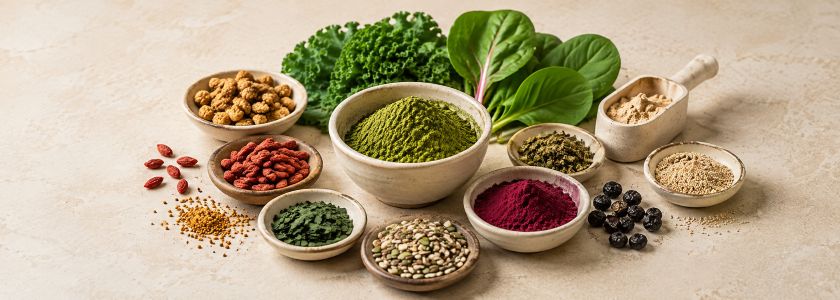
The superfoods category can include:
- greens powders;
- single-ingredient food powders;
- algae-based ingredients such as spirulina or chlorella;
- beetroot and other vegetable powders;
- sea-vegetable or sea-moss products;
- multi-ingredient superfood blends; and
- broader all-in-one nutrition powders.
These should not automatically be compared as though they serve the same purpose.
Start With the Ingredient List
The ingredient list is one of the most useful places to begin because it shows what the product is actually made from.
When comparing superfoods, check:
- whether the product contains one ingredient or many;
- which ingredients appear first;
- whether ingredients are whole-food powders, concentrates or extracts;
- whether vitamins, minerals or other nutrients have been added;
- whether flavours, sweeteners or other ingredients are included;
- whether individual ingredient amounts are disclosed; and
- allergen and dietary information where relevant.
Single-Ingredient Superfoods vs Blended Formulas
A single-ingredient product is generally easier to understand because the label is centred on one food ingredient.
A blended superfood formula can contain many components, such as vegetable powders, fruit powders, algae, herbs, fibre, vitamins, minerals or other added ingredients.
Neither format is automatically better.
When comparing a blend, consider whether the label clearly explains:
- which ingredients are included;
- the order in which they appear;
- whether individual quantities are stated;
- the complete serving size; and
- whether added nutrients or other active ingredients are present.
Greens Powders Are a Major Superfood Format
Greens powders can differ substantially in composition. Some are primarily based on grasses, vegetables or algae, while others are broader blends containing fruit powders, herbs, fibre, vitamins, minerals or other ingredients.
A product with a long ingredient list is not automatically more comprehensive or more suitable than a simpler formula.
Compare the actual ingredient panel and serving information rather than the total number of ingredients alone.
For a more detailed comparison, see the Greens Powders & Superfood Blends Guide once available.
Check the Nutrition Information Panel
Most packaged foods in Australia carry a Nutrition Information Panel.
Food Standards Australia New Zealand states that the standard panel provides average quantities of:
- energy;
- protein;
- fat;
- saturated fat;
- carbohydrate;
- sugars; and
- sodium.
Other nutrients can also appear when relevant to a claim or product formulation.
The panel normally provides values both per serving and per 100 g, or per 100 mL for liquids.
Per Serving and Per 100 g Tell You Different Things
The per serving column shows what the manufacturer-defined serving provides.
The per 100 g or per 100 mL column gives a consistent basis for comparing similar products when their serving sizes differ.
Both are useful.
When comparing superfood powders, check whether one product uses a much smaller or larger recommended serving than another before drawing conclusions from the per-serving figures.
A Bigger Serving Is Not Automatically Better
Superfood powders can use quite different serving sizes.
A larger scoop can produce higher per-serving nutrient numbers simply because more product is being consumed.
Compare:
- grams per serving;
- number of serves per container;
- nutrition information per serving;
- nutrition information per 100 g; and
- how the product is intended to be prepared.
Check Whether Added Vitamins and Minerals Are Present
Some superfood blends are primarily food-based powders, while others contain added vitamins, minerals or other nutrients.
This can make two products that look similar on the front of the pack quite different in formulation.
If added vitamins or minerals are present, check:
- which nutrients are included;
- their amounts per serving;
- whether you already obtain those nutrients from other supplements; and
- whether the product is still best compared with a food powder or with a broader nutrition formula.
Do Not Judge a Product Only by Ingredient Count
Some superfood blends advertise a large number of ingredients.
The number of ingredients does not tell you how much of each ingredient is present or whether the formula is suitable for your needs.
A shorter formula may provide clearer ingredient amounts, while a larger blend may provide broader variety.
The more useful comparison is the actual composition and serving information rather than the headline ingredient count.
Front-of-Pack Claims Need Context
Food labels can carry nutrition content claims and health claims.
Food Standards Australia New Zealand explains that nutrition content claims describe the presence or amount of a nutrient or substance, while health claims describe a relationship between food and a health effect.
These claims are regulated under the Food Standards Code, but a compliant claim should still be considered alongside the complete Nutrition Information Panel and ingredient list.
For example, a product highlighting one nutrient can still differ substantially from another product in energy, sugars, sodium, fibre, ingredients or serving size.
“Natural”, “Organic” and Similar Terms Do Not Replace Comparison
Marketing language can influence how a superfood product is perceived, but it does not replace reading the current label.
Check what the product actually contains, how much is supplied per serving and what nutrition information is provided.
The planned Understanding Nutrition and Food Claims Guide will cover common label claims in more detail.
Superfood Powders Are Not Automatically Equivalent to Whole Foods
Powders can be convenient, but drying, concentrating, blending and processing can produce a product with a different composition from the original fresh food.
This does not automatically make a powder better or worse. It means the finished product should be assessed on its own label and formulation.
A concentrated powder can also use a much smaller serving than the original food, so direct comparisons need context.
Consider How You Will Actually Use the Product
Superfood products can be added to:
- water;
- smoothies;
- yoghurt;
- breakfast foods;
- recipes; or
- other prepared foods and drinks.
The final nutrition profile can change depending on what the product is mixed with.
For example, a powder mixed with water and the same powder added to a smoothie containing milk, fruit and other ingredients will form part of very different overall servings.
Superfoods and the Overall Diet
Australian dietary guidance focuses on eating a wide variety of nutritious foods from the five food groups.
No individual powder, blend or “superfood” determines the overall quality of a diet.
Superfood products can be convenient additions to different dietary patterns, but they should be considered alongside the rest of the foods and drinks consumed over time.
A Practical Superfoods Buying Checklist
- What type of product is it? Identify whether it is a single ingredient, greens powder, blend or broader nutrition formula.
- What are the main ingredients? Read the ingredient list rather than relying on the front-label description.
- Are individual ingredient amounts disclosed? This can make multi-ingredient blends easier to compare.
- What is the serving size? Compare grams per serving as well as scoop size.
- What does the Nutrition Information Panel show? Check energy, protein, fat, carbohydrate, sugars and sodium.
- Can you compare per 100 g? This is useful when serving sizes differ.
- Are vitamins or minerals added? Check for overlap with other nutrition products or supplements.
- Are flavours or sweeteners included? Review the complete ingredient list.
- What claims are being made? Check front-label claims against the detailed product information.
- How will you use it? Consider the product within the rest of your diet rather than in isolation.
Frequently Asked Questions
Is “superfood” an official food category?
No. “Superfood” is a commonly used retail and marketing term rather than a separate food group under Australian dietary guidance.
Are all superfood powders similar?
No. They can differ considerably in ingredients, serving size, nutrient profile, added vitamins and minerals, flavouring ingredients and intended use.
Is a product with more ingredients better?
Not automatically. Ingredient count does not show how much of each ingredient is present or whether the blend is appropriate for your needs.
Are greens powders the same as superfood blends?
Not always. Greens powders are often centred on green vegetables, grasses or algae, while broader superfood blends may contain fruit powders, herbs, fibre, vitamins, minerals and other ingredients.
Should I compare superfoods per serving or per 100 g?
Both can be useful. Per-serving values show what the stated serving provides, while per-100 g values allow easier comparison between similar products using different serving sizes.
Does “organic” mean a superfood product is nutritionally better?
Not necessarily. Organic status and nutritional composition are different considerations. Check the ingredient list, Nutrition Information Panel and serving size as well.
Can a superfood powder replace eating a varied diet?
No individual powder or blend replaces the role of an overall varied diet. Australian dietary guidance recommends enjoying a wide variety of nutritious foods from the five food groups.
Are nutrition and health claims regulated?
Yes. In Australia and New Zealand, nutrition content claims and health claims are subject to requirements in the Food Standards Code.
Further Information
- Food Standards Australia New Zealand — Nutrition Information Panels
- Food Standards Australia New Zealand — Nutrition Content Claims and Health Claims
- Eat For Health — Food Essentials
- Eat For Health — How to Add Variety to Your Diet
Important Information
This guide provides general information to help compare superfoods, including greens powders, single-ingredient food powders, blended formulas and other packaged superfood products. It is not intended to provide personalised dietary or medical advice and does not replace advice from an appropriately qualified health professional.
Individual dietary needs vary according to factors such as age, life stage, activity level, medical conditions, allergies, intolerances and overall dietary pattern. If you have specific nutrition requirements, a medical condition, food allergy or intolerance, or need personalised dietary advice, speak with an appropriately qualified health professional.
Always check the current ingredient list, allergen information, Nutrition Information Panel, serving size, preparation directions and any warnings on the individual product.
Product formulas, directions and warnings can change. Always check the current product label before purchase and use.