
Slippery Elm Supplements: What to Know Before You Buy

Slippery elm supplements can vary in format, serving size and whether slippery elm is the main ingredient or one component of a broader herbal formula. Some products use slippery elm bark powder on its own, while others combine it with additional herbs or nutrients.
This guide explains how to compare slippery elm supplements by looking at botanical identity, bark powder, dosage form, serving amounts, combination formulas and current product labels before choosing.
What Is Slippery Elm?
Slippery elm is the common name for Ulmus rubra, a tree native to North America. The inner bark has a history of traditional use and contains mucilage, a substance that becomes thick and gel-like when mixed with water.
Australian TGA records include listed medicines containing Ulmus rubra and slippery elm bark powder, confirming its use as an active herbal ingredient in complementary medicines.
If you are new to comparing botanical supplements generally, the Herbal Supplements Guide explains botanical names, plant parts, dosage forms and combination formulas in more detail.
Start With the Botanical Name and Plant Part
Look for Ulmus rubra in the ingredient information where the botanical name is stated.
The plant part is also important. Slippery elm supplements are commonly based on bark material, and Australian ARTG entries specifically identify slippery elm bark powder in listed medicines.
When comparing products, check:
- the common and botanical name;
- the plant part used;
- whether the ingredient is supplied as bark powder or another preparation;
- the amount provided per recommended serving; and
- whether slippery elm is the principal ingredient or part of a broader formula.
Powder, Capsules and Tablets Can Differ
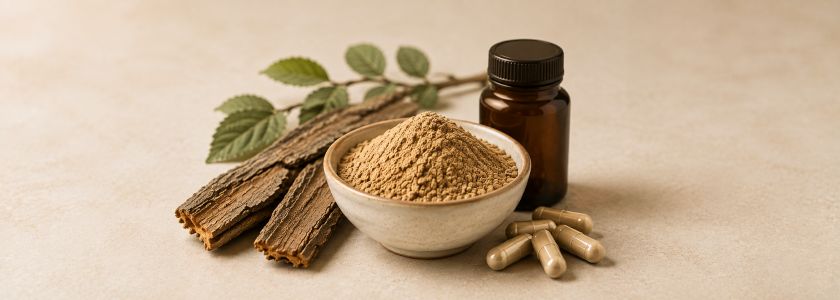
Slippery elm is available in several dosage forms, including loose powder, capsules and tablets.
Powders may be measured by spoon or scoop and mixed according to the individual product directions.
Capsules and tablets provide pre-measured amounts, but serving size can vary considerably between products.
Do not assume one format is automatically stronger or better. Compare the actual amount of slippery elm bark supplied in the complete recommended serving.
Understand Slippery Elm Bark Powder
Slippery elm bark powder contains naturally occurring mucilage. When mixed with liquid, this material can form a thick or viscous consistency.
This physical characteristic is one reason powder products may have preparation directions that differ from standard herbal capsules or tablets.
Always follow the individual product instructions for:
- how much powder to use;
- how much liquid to add;
- how the mixture should be prepared;
- how often it should be used; and
- any storage directions.
Compare the Complete Recommended Serving
Serving sizes can differ significantly between slippery elm products.
Check:
- the amount in each capsule, tablet or measured quantity of powder;
- how many units make up one serving;
- how many servings are recommended each day; and
- the total amount of slippery elm supplied in the full recommended daily use.
Do not compare one capsule from one product with the full daily serving from another.
Single-Ingredient Slippery Elm vs Combination Formulas
Some products contain slippery elm as the main active ingredient, while others include it as one component of a broader digestive or herbal formula.
This distinction matters because a combination product containing slippery elm should not automatically be treated as equivalent to a dedicated slippery elm supplement.
When comparing a combination formula, check:
- how much slippery elm is actually supplied;
- what other active ingredients are included;
- whether those ingredients overlap with other products you use; and
- the complete serving size and directions.
For more detail on this type of comparison, see the Herbal Combination Formulas Guide.
Do Not Assume All Slippery Elm Products Are Equivalent
Two products using the same common ingredient name can still differ in dosage form, amount per serving, number of servings per day and whether additional active ingredients are included.
Compare the full label rather than choosing only by:
- the product name;
- front-label wording;
- capsule or tablet size;
- container size; or
- the number of ingredients in the formula.
Traditional Use and Modern Evidence Are Different
Slippery elm has a history of traditional use, but traditional use and modern clinical evidence are not the same thing.
Evidence for many commonly promoted uses remains limited. For example, recognised medical sources note that human evidence is lacking for several proposed uses, and some studies have involved multi-ingredient formulas rather than slippery elm alone.
This means research on a particular blend should not automatically be interpreted as evidence for every slippery elm product.
Check the Australian Medicine Label
Where slippery elm is supplied as a complementary medicine in Australia, check the current label for the relevant Australian medicine identification information.
You may see:
- AUST L — listed medicine;
- AUST L(A) — assessed listed medicine; or
- AUST R — registered medicine.
The AUST number helps identify the product and its regulatory pathway, but it does not tell you which slippery elm supplement is most suitable for you.
Check Directions and Warnings Carefully
Directions can differ between powders, capsules, tablets and combination formulas.
Always check:
- the recommended serving;
- how often the product should be used;
- how powders should be prepared;
- age restrictions;
- pregnancy or breastfeeding advice;
- medicine interaction information;
- allergen information where relevant; and
- storage instructions.
Consider Medicine and Supplement Interactions
Herbal products can interact with medicines or other supplements, and combination formulas can make ingredient overlap harder to identify.
If you take prescription or over-the-counter medicines, have a medical condition, are pregnant or breastfeeding, are preparing for surgery, or are uncertain whether a slippery elm supplement is suitable for you, speak with a pharmacist, doctor or other appropriately qualified health professional before use.
If you use a powdered product that forms a thick mixture, follow the preparation and timing directions on the current label rather than assuming it can be taken in the same way as other supplements.
A Practical Slippery Elm Buying Checklist
- Is the ingredient actually slippery elm? Look for Ulmus rubra where the botanical name is stated.
- Which plant part is used? Check for bark or bark powder information.
- Which dosage form suits you? Compare powders, capsules and tablets based on the actual serving instructions.
- What does the full serving provide? Compare complete recommended servings rather than individual units.
- Is slippery elm the main ingredient? Combination formulas may contain only one component of a broader blend.
- Are other active ingredients included? Check for overlap with supplements you already use.
- How should powder be prepared? Follow the current mixing and serving directions.
- Is an AUST number present? Check the regulatory identification where applicable.
- What warnings apply? Read the current product label carefully.
Frequently Asked Questions
What part of slippery elm is used in supplements?
Slippery elm supplements commonly use bark material. Australian ARTG records include products specifically identified as containing slippery elm bark powder.
Is slippery elm powder the same as capsules?
Not exactly. Capsules may contain slippery elm powder in a pre-measured form, while loose powder is measured and prepared according to the product directions. Compare the actual amount supplied in the complete serving.
Why does slippery elm powder become thick when mixed with water?
Slippery elm bark naturally contains mucilage, which can form a thick or viscous consistency when combined with liquid.
Are combination products containing slippery elm the same as dedicated slippery elm supplements?
No. A combination formula may contain slippery elm alongside several other active ingredients. Check how much slippery elm is supplied and compare the complete formula.
Does a higher milligram amount mean a better slippery elm supplement?
Not necessarily. Compare the complete serving size, dosage form, directions and full formula rather than using milligrams alone as a quality measure.
Is there strong clinical evidence for every traditional use of slippery elm?
No. Slippery elm has a history of traditional use, but recognised medical sources note that human evidence for several promoted uses remains limited. Evidence from a multi-ingredient formula should not automatically be applied to slippery elm alone.
Can slippery elm be taken with medicines?
That depends on the product and your circumstances. If you use prescription or over-the-counter medicines or are uncertain about timing or combination with other products, seek advice from an appropriately qualified health professional.
Further Information
- Therapeutic Goods Administration — Slippery Elm 400mg ARTG Record
- Therapeutic Goods Administration — MediHerb Slippery Elm 400mg ARTG Record
- Memorial Sloan Kettering Cancer Center — Slippery Elm
Important Information
This guide provides general information to help compare slippery elm supplements, including bark powders, capsules, tablets, serving information and combination formulas. It is not intended to diagnose, treat, cure or prevent a medical condition and does not replace advice from a qualified health professional.
Herbal and complementary medicines can cause side effects and may interact with prescription medicines, over-the-counter medicines and other supplements. If you take medicines, have a medical condition, are pregnant or breastfeeding, are preparing for surgery, or are uncertain whether a slippery elm product is suitable for you, speak with an appropriately qualified health professional before use.
Always follow the preparation directions and warnings on the individual product label. Do not assume that products containing slippery elm have the same dosage form, serving amount, ingredient profile or suitability.
Product formulas, directions and warnings can change. Always check the current product label before purchase and use.