Medicinal Mushrooms: What to Know Before You Buy

Medicinal mushroom supplements can vary considerably in species, part of the mushroom used, processing method, extract type, serving size and whether the product contains a single mushroom or a blend. Comparing the complete ingredient and label information is more useful than choosing a product based only on a familiar mushroom name.
This guide explains how to compare medicinal mushroom supplements, including species identity, powders and extracts, single-mushroom products, multi-mushroom blends, serving information, Australian medicine labels and important safety considerations.
What Are Medicinal Mushroom Supplements?
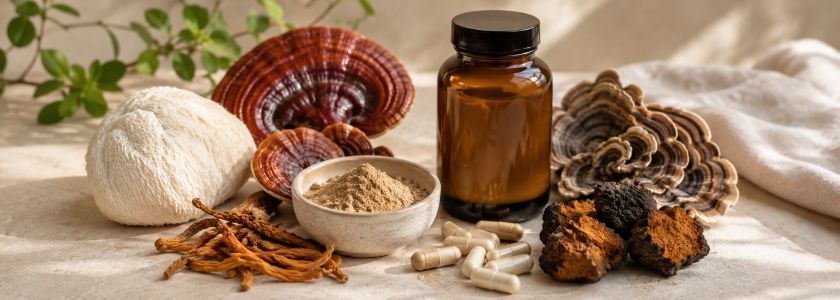
Medicinal mushroom supplements are products containing mushrooms or mushroom-derived ingredients used in traditional or contemporary wellness products. Common examples include Lion’s Mane, Reishi, Cordyceps, Turkey Tail and Chaga.
They are available in several formats, including powders, capsules and concentrated extracts. You can browse the current Medicinal Mushrooms range to see how individual mushroom products, blends and formats differ.
In Australia, mushroom products can fall under different regulatory frameworks depending on how they are presented and supplied. Products sold as foods are regulated differently from products presented for therapeutic use. Mushroom extracts, capsules or products making therapeutic claims are more likely to be regulated as therapeutic goods.
Start With the Mushroom Species
Different mushroom species are not interchangeable. Before comparing serving sizes or extract strengths, check which species the product actually contains.
Common medicinal mushroom ingredients include:
- Lion’s Mane — commonly identified as Hericium erinaceus;
- Reishi — commonly associated with Ganoderma species;
- Cordyceps — products may use species such as Cordyceps militaris or related preparations;
- Turkey Tail — commonly associated with Trametes versicolor; and
- Chaga — commonly identified as Inonotus obliquus.
Some products contain one species only, while others combine several mushrooms in a blend. Always check the complete ingredient panel rather than assuming the front label tells you the full formula.
Powders and Extracts Are Not the Same Thing
Mushroom powders and concentrated extracts can differ substantially. A powder may contain dried and milled mushroom material, while an extract has undergone additional processing to concentrate selected components.
When comparing products, look for:
- the exact mushroom species;
- the form of the ingredient;
- whether the product is a powder or extract;
- the amount supplied per recommended serving;
- any extract ratio or equivalent amount stated; and
- any declared standardisation or constituent information.
Do not assume that a larger milligram number automatically means a stronger or more suitable product. Different preparations may not be directly comparable.
Fruiting Body, Mycelium and Other Mushroom Material
Mushroom products may use different parts or stages of the fungal organism. Labels may refer to fruiting body material, mycelium or another preparation.
The fruiting body is the visible mushroom structure most people recognise. Mycelium is the network of fungal material from which the fruiting body develops. Some products may contain one, the other or a combination.
This distinction can matter because products made from different materials may have different compositions and processing methods. Check exactly what the label states rather than assuming all products using the same mushroom name are equivalent.
Single-Mushroom Products vs Mushroom Blends
Single-mushroom products make it easier to identify how much of one species is being supplied. Multi-mushroom blends combine several species and may be designed as broader formulas.
Neither approach is automatically preferable. The useful comparison is whether the formula provides clear ingredient amounts and whether it suits what you are looking for.
When comparing a blend, check:
- which mushroom species are included;
- the amount of each species where stated;
- whether each ingredient is a powder or extract;
- whether some ingredients are present in much smaller amounts than others; and
- whether other herbs or nutrients are included alongside the mushrooms.
A product marketed around one familiar mushroom may still contain several additional ingredients, so always read the full formula.
Understand Beta-Glucan and Polysaccharide Information
Mushrooms naturally contain polysaccharides, including beta-glucans. Some supplement labels provide information about beta-glucan content or other constituents, while others do not.
When this information is provided, check whether the amount refers to:
- the ingredient itself;
- the complete extract;
- a stated percentage; or
- the total recommended serving.
Do not assume that a product is automatically better because it displays a particular constituent percentage. Species, raw material, processing, serving amount and the complete formula all need to be considered together.
Compare the Recommended Serving
Medicinal mushroom supplements can use very different serving sizes. Powders may be measured in grams or scoops, while capsules provide pre-measured amounts.
Check:
- the amount in each capsule, scoop or measured serving;
- how many units make up the recommended serving;
- how often the product is directed to be used;
- the total amount of each mushroom species supplied; and
- whether the amount shown relates to powder, extract or an equivalent quantity.
Compare complete recommended servings rather than one capsule from one product with a full daily serving from another.
Food Products and Therapeutic Goods Are Regulated Differently
Not every mushroom product is regulated in the same way. In Australia, mushroom products supplied as foods are subject to food regulation, while products presented for therapeutic use may be regulated as therapeutic goods.
The Therapeutic Goods Administration advises that mushroom products are more likely to be therapeutic goods when they:
- are supplied in capsule or tablet form;
- contain concentrated mushroom extracts;
- are presented as traditional medicines;
- provide medicine-style dosage directions; or
- make therapeutic claims.
Where a mushroom supplement is supplied as a medicine, check the label for the relevant Australian medicine identification number.
Check the AUST Number Where Applicable
Medicines included in the Australian Register of Therapeutic Goods display an AUST identification number on the label.
You may see:
- AUST L — listed medicine;
- AUST L(A) — assessed listed medicine; or
- AUST R — registered medicine.
These pathways do not involve the same level of pre-market assessment. Listed medicines are not individually evaluated by the TGA for efficacy before supply, while assessed listed and registered medicines have additional assessment requirements.
The AUST number helps identify the product’s regulatory pathway, but it does not by itself tell you which mushroom supplement is most suitable for you.
Traditional Use and Scientific Evidence Are Different
Several medicinal mushrooms have histories of use within traditional medicine systems. Traditional-use information can help explain why particular mushrooms are included in supplements, but it should not be treated as equivalent to modern clinical evidence.
Research also varies between mushroom species, extracts, preparations and intended uses. Findings involving one specific mushroom preparation should not automatically be applied to every powder, extract or blend carrying the same common name.
This is another reason to compare the actual ingredient and preparation rather than relying on broad claims about a mushroom species.
Check for Ingredient Overlap and Medicine Interactions
Mushroom supplements can appear as single ingredients, multi-mushroom blends or as part of broader herbal formulas. If you use several supplements, check whether the same mushroom or another active ingredient is repeated across products.
Natural products can still cause side effects or interact with medicines. The TGA advises consumers to tell their doctor about complementary medicines they use, particularly if they take prescription medicines or are preparing for surgery.
If you take prescription or over-the-counter medicines, have a medical condition, are pregnant or breastfeeding, or are unsure whether a medicinal mushroom product is suitable for you, speak with a pharmacist, doctor or other appropriately qualified health professional before use.
A Practical Medicinal Mushroom Buying Checklist
- Which mushroom species is used? Check the common and botanical names where available.
- Is it a single mushroom or a blend? Review the complete ingredient panel.
- Is it a powder or extract? Do not treat these as directly interchangeable.
- What mushroom material is used? Check whether the label identifies fruiting body, mycelium or another preparation.
- Are extract or constituent details stated? Review any beta-glucan, polysaccharide or standardisation information in context.
- What does the complete serving provide? Compare full recommended servings rather than individual capsules alone.
- Is the product regulated as a medicine? Check for an AUST number where applicable.
- Are there other active ingredients? Combination formulas may contain herbs, nutrients or additional mushrooms.
- What warnings and directions apply? Follow the current product label.
- Could it overlap with medicines or other supplements? Seek professional advice where appropriate.
Frequently Asked Questions
Are all medicinal mushrooms the same?
No. Lion’s Mane, Reishi, Cordyceps, Turkey Tail and Chaga are different mushroom species with different compositions and product preparations. Check the species and complete formula rather than treating them as interchangeable.
Is mushroom powder the same as mushroom extract?
No. Powder generally contains dried and milled material, while extracts have undergone additional processing to concentrate selected components. Their milligram amounts should not automatically be compared directly.
What is the difference between fruiting body and mycelium?
The fruiting body is the visible mushroom structure, while mycelium is the network of fungal material from which mushrooms develop. Supplements may use fruiting body, mycelium or other preparations, so check the product label.
Are mushroom blends better than single-mushroom products?
Not necessarily. A single-mushroom formula provides a more focused ingredient profile, while a blend combines several species. Compare ingredient amounts, forms, serving information and the complete formula rather than assuming one format is inherently better.
What are beta-glucans?
Beta-glucans are naturally occurring polysaccharides found in mushrooms and other organisms. Some mushroom supplement labels provide beta-glucan information, but this should be interpreted alongside species, extract type, serving size and the rest of the formula.
Do medicinal mushroom supplements need an AUST number?
Where a mushroom product is supplied as a therapeutic good in Australia, it generally needs to be included in the Australian Register of Therapeutic Goods and display the relevant AUST identification number. Food products are regulated differently.
Can I take several medicinal mushroom supplements together?
That depends on the formulas and your individual circumstances. Check for repeated mushroom species and other overlapping active ingredients. If you use medicines, have a medical condition, are pregnant or breastfeeding, or are uncertain about combining products, seek advice from an appropriately qualified health professional.
Further Information
- Therapeutic Goods Administration — Advertising Mushroom Products That Are Therapeutic Goods
- Therapeutic Goods Administration — Understanding Complementary Medicines
- Therapeutic Goods Administration — Non-Prescription Medicines
Important Information
This guide provides general information to help compare medicinal mushroom supplement species, formats, extracts, blends and labels. It is not intended to diagnose, treat, cure or prevent a medical condition and does not replace advice from a qualified health professional.
Mushroom supplements and other complementary medicines can cause side effects and may interact with prescription medicines, over-the-counter medicines or other supplements. If you take medicines, have a medical condition, are pregnant or breastfeeding, are preparing for surgery, or are uncertain whether a product is suitable for you, speak with an appropriately qualified health professional before use.
Always follow the directions and warnings on the individual product label. Do not assume that products containing the same mushroom species have the same raw material, extract, constituent profile, serving size or suitability.
Product formulas, directions and warnings can change. Always check the current product label before purchase and use.