
Herbal Capsules, Tablets & Powders: What to Know Before You Buy

Herbal capsules, tablets and powders can contain many of the same botanical ingredients, but the dosage form alone does not tell you which product is stronger, more concentrated or more suitable. Differences in plant part, extract type, ingredient amount, serving size and combination formulas are usually more important than whether the product comes as a capsule, tablet or powder.
This guide explains how to compare herbal capsules, tablets and powders by looking at ingredient form, extracts, serving information, combination formulas, convenience and product labels before choosing.
How Do Herbal Capsules, Tablets and Powders Differ?
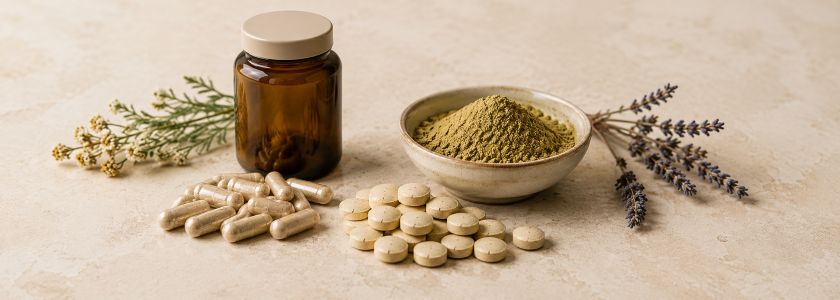
Capsules, tablets and powders are different ways of delivering herbal ingredients. Each format can contain whole or powdered plant material, concentrated extracts, standardised herbal ingredients or combinations of several herbs and other active ingredients.
You can browse the current Herbal Capsules, Tablets & Powders range to see how these formats and formulas differ.
The most useful comparison is therefore not simply “capsule versus tablet versus powder”. Start by checking what active ingredients the product contains and how much the recommended serving provides.
Herbal Capsules
Capsules are widely used for herbal supplements because they provide a pre-measured amount and can contain powders, granules or extracts.
When comparing herbal capsules, check:
- how many capsules make up the recommended serving;
- the amount of each active ingredient per capsule and per full serving;
- whether the ingredient is whole herb, powder or extract;
- any dry-herb equivalent or standardised constituent information;
- whether the capsule contains a single herb or combination formula; and
- the directions and warnings on the current label.
One capsule from one product should not automatically be compared with one capsule from another. Capsule size, extract concentration and recommended daily serving can all differ.
Herbal Tablets
Tablets also provide pre-measured servings but are manufactured by compressing ingredients into a solid dosage form. Depending on the formula, a tablet may contain herbal extracts alongside vitamins, minerals or other active ingredients.
Check the full ingredient panel rather than assuming that a larger tablet contains more of the herb you are interested in. The physical size of a tablet can reflect the complete formula, including other active and inactive ingredients.
Some tablets are designed to be swallowed whole, while others may have different directions. Always follow the instructions for the specific product.
Herbal Powders
Powders may contain dried and milled plant material, concentrated herbal preparations or multi-ingredient blends. They are usually measured by scoop, spoon or another stated serving rather than by capsule or tablet count.
When comparing powders, check:
- the recommended serving weight;
- how the serving is measured;
- the amount of each active ingredient per serving;
- whether the product contains whole herb or an extract;
- whether other herbs, nutrients or flavouring ingredients are included; and
- the preparation and mixing directions.
A larger scoop does not necessarily mean a more concentrated herbal formula. Compare the actual active ingredient declaration.
Whole Herb and Herbal Extracts Are Different
Herbal ingredients are complex plant-derived substances, and extracts can have different profiles depending on the extraction method used. The TGA notes that different extraction methods and solvents can change the composition of herbal ingredients. :contentReference[oaicite:2]{index=2}
A whole-herb powder and a concentrated extract should therefore not be compared only by their milligram figures.
A label may show:
- the physical amount of extract used;
- an amount equivalent to a larger quantity of dry or fresh herb;
- an extraction ratio;
- the plant part used; or
- a standardised amount of a particular herbal constituent.
If you want more background on these concepts, the Herbal Supplements Guide explains plant parts, extracts, equivalent amounts and combination formulas in more detail.
Compare the Full Recommended Serving
Serving size is one of the most important differences between herbal dosage forms.
A product may direct you to take:
- one capsule once daily;
- several capsules across the day;
- one or more tablets per serving; or
- a measured amount of powder.
Compare the total amount supplied by the complete recommended serving rather than comparing individual capsules, tablets or scoops in isolation.
Also check whether the label gives different directions for different intended uses or age groups.
Single-Herb Products vs Combination Formulas
Capsules, tablets and powders can all be either single-herb products or multi-ingredient formulas.
A single-herb product usually makes it easier to identify the amount and form of one botanical ingredient. Combination formulas may include several herbs or add vitamins, minerals or other nutrients.
When comparing a combination formula, check:
- how much of each active ingredient is supplied;
- whether the main herb is present in a meaningful amount;
- which other herbs and nutrients are included;
- whether any ingredients overlap with supplements you already use; and
- whether the full formula suits what you are trying to compare.
A familiar herb appearing somewhere in a long ingredient list does not make the product equivalent to a dedicated supplement based primarily on that herb.
Do Capsules, Tablets or Powders Absorb Better?
Dosage form alone is not enough to determine how effectively a herbal ingredient will be absorbed. The botanical ingredient, extract type, formulation, serving amount and other ingredients can all influence the finished product.
Do not assume that powders are automatically absorbed better because they are loose, or that capsules are automatically more effective because they are enclosed. Compare the actual formulation and label information rather than relying on the dosage form alone.
Which Format Is More Convenient?
Convenience is a practical consideration and may influence which format you prefer.
Capsules provide pre-measured servings and are easy to count.
Tablets also provide fixed amounts and can accommodate multi-ingredient formulas.
Powders may suit people who prefer mixing a product according to its directions, but they require accurate measuring and may have a more noticeable taste or texture.
The most convenient format is the one you can use correctly and consistently according to its current label directions.
Check the Botanical Name and Plant Part
The same common herb name can refer to products using different botanical preparations. Where provided, check the botanical species and which plant part is used.
Depending on the herb, products may contain root, leaf, fruit, bark, seed, flower, rhizome or another part of the plant.
This is particularly important when comparing concentrated extracts. Two products with similar front-label wording may contain different plant parts or extract preparations.
Understand AUST Numbers on Herbal Medicines
Many herbal supplements supplied as medicines in Australia are complementary medicines included in the Australian Register of Therapeutic Goods.
Depending on the regulatory pathway, medicine labels may display:
- AUST L — listed medicine;
- AUST L(A) — assessed listed medicine; or
- AUST R — registered medicine.
AUST L medicines use permitted lower-risk ingredients and are not individually evaluated by the TGA for efficacy before supply. AUST L(A) medicines undergo pre-market assessment of their indications, while AUST R complementary medicines undergo a fuller pre-market evaluation. :contentReference[oaicite:3]{index=3}
The AUST number is useful for understanding the regulatory pathway, but it does not by itself tell you whether a capsule, tablet or powder is the most suitable choice.
Traditional Use and Scientific Evidence
Some herbal medicines are supported by a recognised history of traditional use rather than modern scientific evidence. The TGA requires this distinction to be reflected on relevant medicine labels. :contentReference[oaicite:4]{index=4}
Traditional use can help explain why an ingredient is included in a product, but it is not the same as evidence from modern clinical research.
Also remember that research involving one specific herbal extract or preparation should not automatically be applied to every capsule, tablet or powder containing the same common herb.
Check Warnings and Ingredient Overlap
Herbal products can cause side effects and can interact with prescription medicines, over-the-counter medicines and other supplements. The TGA advises consumers to tell health professionals about complementary medicines they use, particularly when taking medicines or preparing for surgery. :contentReference[oaicite:5]{index=5}
Check all of your products for repeated herbal ingredients, vitamins, minerals or other actives.
If you take medicines, have a medical condition, are pregnant or breastfeeding, are preparing for surgery, or are uncertain whether a herbal product is suitable for you, speak with a pharmacist, doctor or other appropriately qualified health professional before use.
A Practical Capsules, Tablets & Powders Buying Checklist
- What is the active herbal ingredient? Check the botanical name and plant part where stated.
- Is it whole herb or an extract? Do not compare different preparations only by milligrams.
- What does the full serving provide? Compare complete recommended servings rather than individual capsules, tablets or scoops.
- Is it a single-herb or combination formula? Check all active ingredients.
- Does the label show an equivalent amount? Distinguish this from the physical extract amount.
- Is standardisation information provided? Consider this alongside the complete formula.
- Which dosage form suits you? Consider convenience, measuring, swallowing and preparation directions.
- Is an AUST number present? Check the regulatory identification where applicable.
- What warnings apply? Read the current label rather than relying on an older product description.
- Could ingredients overlap? Review other supplements and medicines you use.
Frequently Asked Questions
Are herbal capsules better than tablets?
Not necessarily. Capsules and tablets are simply different dosage forms. Compare the active ingredients, extracts, serving amounts, directions and complete formula rather than assuming one format is inherently better.
Are herbal powders stronger than capsules?
Not automatically. A powder may contain whole herb, extract or a combination formula, just as a capsule can. Strength depends on the actual ingredient preparation and serving amount.
Can I open herbal capsules and mix the powder into food or drinks?
Only do this if the current product directions allow it or an appropriately qualified health professional advises you to do so. Some products are designed to be swallowed intact, and changing how they are used may not be appropriate.
Why do some herbal products show very large equivalent amounts?
Concentrated herbal extracts may be labelled with the amount of original plant material they are equivalent to. This can be much larger than the physical amount of extract in the product. Compare the complete ingredient declaration rather than assuming the largest number means the strongest product.
Does a bigger tablet or capsule contain more active herb?
Not necessarily. Physical size can reflect other active ingredients and inactive ingredients as well as the herb itself. Check the active ingredient amounts on the label.
Are combination herbal formulas better than single-herb supplements?
Neither is automatically better. Single-herb products provide a more focused ingredient profile, while combination formulas contain several actives. Compare the complete formula and amounts according to what you need to understand.
Do all herbal capsules, tablets and powders have an AUST number?
Products supplied as therapeutic medicines in Australia generally need to be included in the Australian Register of Therapeutic Goods and display the appropriate AUST identification. Products supplied under other regulatory frameworks may differ, so check the individual label.
Further Information
- Therapeutic Goods Administration — Understanding Complementary Medicines
- Therapeutic Goods Administration — Herbal Ingredients
- Therapeutic Goods Administration — Non-Prescription Medicines
- Therapeutic Goods Administration — What's on My Medicine Label?
Important Information
This guide provides general information to help compare herbal capsules, tablets and powders, including ingredient forms, extracts, serving information and labels. It is not intended to diagnose, treat, cure or prevent a medical condition and does not replace advice from a qualified health professional.
Herbal and complementary medicines can cause side effects and may interact with prescription medicines, over-the-counter medicines and other supplements. If you take medicines, have a medical condition, are pregnant or breastfeeding, are preparing for surgery, or are uncertain whether a product is suitable for you, speak with an appropriately qualified health professional before use.
Always follow the directions and warnings on the individual product label. Do not assume that capsules, tablets or powders containing the same herb have the same plant part, extract, concentration, serving size or suitability.
Product formulas, directions and warnings can change. Always check the current product label before purchase and use.